The first era of enterprise AI was about access to intelligence. The next is about what you do with it.
Every major enterprise now has access to the same frontier models. The gap between organizations will not be determined by which model they use. It will be determined by whether they built the layer that turns AI intelligence into reliable business execution.
That layer is the Company Harness. Most enterprises don't have one. And without it, they are building on a foundation they don't own, can't control, and may not be able to change.
What makes Upware's Company Harness different from every other orchestration or workflow tool is two things that the industry has not solved before: it self-constructs from your existing agents (prompts, intent, plans), processes and institutional knowledge, and it self-evolves with every execution — continuously optimizing itself for accuracy, cost, and speed without requiring engineering effort to maintain it. It also integrates with any model or agent framework your organization already uses — Claude, GPT, Cowork, Gemini, Copilot Studio, n8n, LangGraph, AutoGen, CrewAI, and more — so you never have to choose between your harness and your preferred AI stack.
Enterprise AI Has a Missing Layer
For the past several years, the dominant approach to enterprise AI has been model-centric: pick a capable model, give it tools and context, and let it reason its way to a result.
This works well for exploration. For business processes, it creates a category error.
A model can reason about how a billing dispute should be resolved without knowing:
- Which system is authoritative for that customer's record
- Which employee tier has approval authority for this exception
- What the correct post-resolution state across four downstream systems should look like
- Which regulatory constraint changes the permitted action
Even when it reasons correctly, its output is probabilistic. And in business operations, the gap between "usually right" and "always right" is exactly where the liability lives.
The wrong answer in a conversation is a nuisance. The wrong action in a billing, claims, lending, or servicing process is an operational event — one that compounds across volume, across quarters, and across the enterprise's reputation.
The problem, it turns out, is not intelligence. Enterprises have access to extraordinary intelligence. The problem is that nothing is harnessing that intelligence to the actual work.
The Coding World Already Solved This
The concept of a harness is not new. It is foundational to how AI already works in the one domain where it has become genuinely reliable: software development.
AI coding agents don't operate in isolation. They operate inside environments that provide:
- Access to repositories, compilers, and test runners so the model knows the state of the codebase
- Terminal and version control integration so actions have predictable, reversible effects
- Permission models so the agent can't exceed its mandate
- Feedback loops so the agent knows whether its output was correct
The model supplies reasoning. The harness turns that reasoning into working software.
No serious engineering team would deploy an AI coding agent without that infrastructure. The intelligence is necessary but not sufficient. The harness is what makes it production-ready.
Knowledge work needs the same architecture. But the environment is no longer a codebase. It is the company itself: its systems, its rules, its institutional knowledge, its exceptions, its approval chains, its audit obligations, and its operational standards.
That environment has to be built. It does not come with the model.
The Research Is Clear: The Harness Determines the Outcome
Researchers at Stanford University and MIT have made this point with precision. In their study of harness optimization across agent systems, they concluded:
"The performance of large language model systems depends not only on model weights, but also on their harness: the code that determines what information to store, retrieve, and present to the model."
Their findings go further. Well-designed harnesses do not just improve performance on the tasks they were built for. They generalize:
"Harnesses discovered by our search capture generally effective strategies rather than overfitting to specific datasets."
"Readable, transferable strategies can be reused across models, including future, stronger ones."
That last point matters enormously. The harness is not built for one model. It is built for the business. And it carries forward.
The empirical results are striking. Structured, harness-driven approaches achieved a 7.7-point accuracy improvement over state-of-the-art unconstrained agents on text classification tasks, 4x fewer context tokens in the same tasks (11.4K vs 50.8K), and 73.1% average accuracy across 9 unseen datasets — demonstrating generalization, not overfitting.
These results come from academic settings. In production enterprise environments, the magnitude of the difference is larger, because the cost of errors is real and the pressure for consistency is unrelenting.
Why Model Alone Breaks in Production
There are four structural problems with putting the model at the center of enterprise operations.
1. Accuracy is uneven by design.
Harvard Business School's research on AI in knowledge work documented what they called the "jagged technological frontier" — a boundary of tasks where AI dramatically outperforms humans, and tasks where it underperforms, with no reliable signal to tell which side you're on. Inside the frontier: 25% faster, 40%+ more accurate. Outside it: a 19-percentage-point decrease in the probability of reaching the correct answer. This is not a temporary limitation of current models. It is a structural property of probabilistic systems. Better models will move the frontier, but the frontier will always exist.
2. Execution is unpredictable.
The same objective, submitted to the same model on different days, produces different plans, different tool calls, and different numbers of reasoning steps. That flexibility is valuable when you want creativity. It is a liability when your process requires a defined procedure, consistent outcomes, and an audit trail that satisfies a regulator.
3. Cost and latency scale with uncertainty.
An agent that reasons through every step of a process — retrieving context, evaluating options, checking its work — is applying expensive general-purpose intelligence to work that in many cases could be encoded once and executed directly. Research into Compiled AI workflows has documented reductions in token consumption of up to 57x when deterministic steps are factored out of the reasoning loop. Token costs matter; so does latency. Over-reasoning is one of the primary sources of high agent cost and slowness in production.
4. Governance cannot be retrofitted.
Enterprises need to know, before execution begins, what the agent can access, what it can change, which policies apply, and how every action will be logged. The current response is to restrict agents to low-stakes tasks, or require engineering teams to build bespoke guardrails around each use case. Neither approach scales to a real AI workforce.
These are not implementation problems. They are architectural ones. They cannot be resolved by a better model or a smarter prompt. They require a different kind of system.
Business Work Is Not an Open-Ended Problem
There is a productive irony here.
The work enterprises most want agents to perform is structurally the opposite of open-ended reasoning. Business processes have defined inputs and outputs. They have policies, permissions, dependencies, and verification criteria. Many individual steps are entirely deterministic.
Consider a customer policy servicing request. Once the intent is understood, much of what follows is software:
- Retrieve the account from the authoritative system
- Verify eligibility against the policy schedule
- Determine the permitted action given the customer tier and exception history
- Update the relevant systems in the required sequence
- Validate the resulting state
- Record what happened for the audit log
An LLM does not need to reason through any of that. It needs to understand the request. The rest can and should be software.
The right architecture is not to use AI everywhere. It is to use AI where intelligence is actually required, and software everywhere else.
That distinction is what the Company Harness enforces.
Harnessing: From Intent to Execution Graph
At Upware, we implement this through what we call an Execution Graph.
The graph begins where the model ends. An agent — on any model, using any framework — can understand the user's intent and formulate a plan. The harness takes that plan and translates it into a structured, executable representation of the actual business task.
The graph separates work by type:
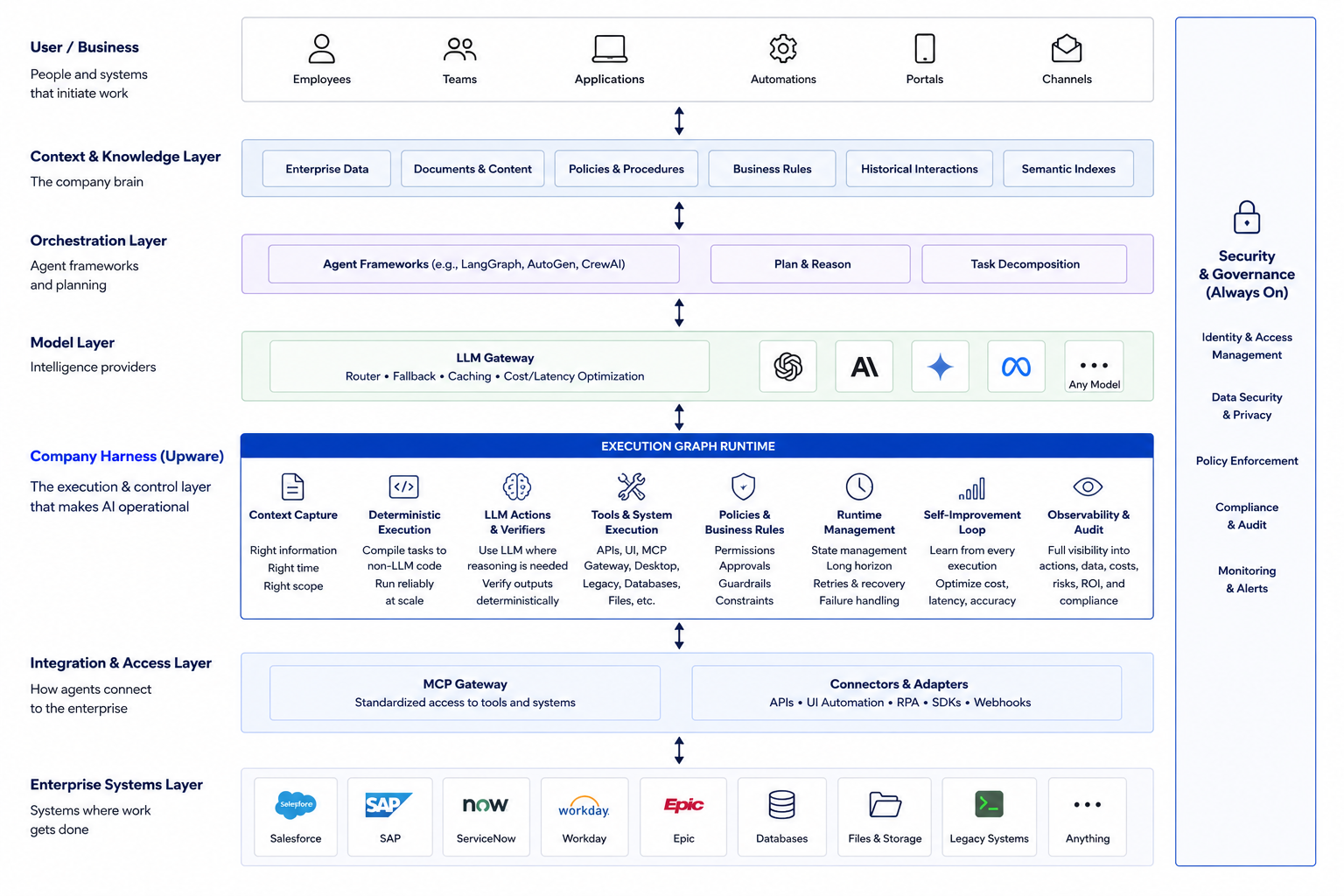
- Deterministic Execution: Steps that can be compiled into direct code are never re-inferred at runtime. They run as software, reliably and at scale.
- LLM Actions and Verifiers: Where genuine reasoning is required, the model is invoked. Its outputs are then verified deterministically before flowing into any consequential action.
- Context Capture: The right information, at the right time, at the right scope — drawn from the company's knowledge layer or from the user, not reconstructed from scratch on every run.
- Tools and System Execution: Across APIs, UI automation, MCP gateways, desktop environments, legacy systems, databases, and files — the full surface area of enterprise work.
- Policies and Business Rules: Permissions, approvals, guardrails, and constraints encoded as first-class runtime logic, not embedded in prompts.
- Runtime Management: State management, long-horizon task execution, retries, recovery, and failure handling — so complex work can be interrupted, resumed, and audited without starting over.
- Self-Improvement Loop: Every execution feeds back into optimization of cost, latency, and accuracy. The system gets better with use.
- Observability and Audit: Full visibility into every action taken, every system touched, every cost incurred, every risk encountered, and every business outcome produced.
This is what compiled AI means in practice. The model is still present. It is just no longer doing work that doesn't require it.
A Harness That Builds — and Improves — Itself
Most enterprise software requires months of engineering to configure, and more engineering every time the business changes. The Company Harness is designed around the opposite principle.
It self-constructs. Using AI to analyze your existing agents, AI interactions, processes, SOPs, workflows, and system interactions, Upware automatically generates the Execution Graph for a business task — translating institutional knowledge into a structured, executable representation without requiring developers to manually code each step. What takes traditional automation teams months takes Upware minutes.
It self-evolves. Every execution generates data: which steps succeeded, which required more model reasoning than expected, where latency spiked, where a policy constraint triggered, what the business outcome was. The Self-Improvement Loop ingests this data continuously, identifying opportunities to compile more steps into deterministic code, tighten verifiers, optimize tools and context, and eliminate unnecessary inference calls. The harness gets more accurate, faster, and cheaper with every run — without anyone having to tune it manually.
This is not a system you build once and maintain forever. It is a system that maintains and improves itself — freeing your teams from the operational burden of AI infrastructure and letting them focus on the work that matters.
And it integrates with your existing AI stack. Whether your organization runs Claude, GPT, Cowork, Gemini, Copilot Studio, n8n, LangGraph, AutoGen, CrewAI, or any combination, the harness connects to it. You don't replace your current models or frameworks — you give them the operating layer they were missing.
Where the Harness Sits in the Enterprise AI Stack
The diagram below shows where the Company Harness sits within the full enterprise AI stack — and why its position at the center is not incidental. The models, the agent frameworks, and the company's knowledge base feed into it. The LLM Gateway, MCP Gateway, integration layer, and enterprise systems are orchestrated by it. Security and governance wrap the entire stack. The harness is the connective tissue that makes the rest of the architecture functional.